Identity Reclamation
Lately I've been thinking about identity. Not in the "find your purpose" kind of way. But in the quieter, deeper way that asks,
Who am I becoming now that I'm no longer surviving?
It's a question I hear often from women after betrayal, divorce, or years spent in emotionally unsafe relationships. Somewhere between surviving and healing, many discover that the person they've always believed themselves to be doesn't feel quite as familiar anymore. At first, that can be unsettling. We assume something must be wrong. We wonder if we're losing ourselves. I know I felt this way.
Yet, I don't think we are necessarily losing ourselves, I think we're meeting parts of ourselves that survival never allowed us to know.
I've been thinking about identity a lot lately. Looking back, I can trace the many versions of myself I've tried on over the years. As a little girl, I wanted to be the one who could throw the football farther than the boys or outrun them on the playground. Later I wanted to be a swimmer. Then a singer. Eventually I became a wife, a mother, a divorced woman, a somatic practitioner, a coach. None of those identities were wrong. They reflected different seasons of my life, different values, different dreams. That's part of being human. We grow, we evolve and we take on new roles as life changes around us.
But somewhere along the way I began wondering if identity was more complicated than simply the roles we occupy. What if some of the qualities we proudly claim as "just who I am" aren't actually expressions of our truest selves? What if some of them are adaptations and remarkably intelligent ones that developed because our nervous systems believed they were necessary for survival?
That question changed the way I began looking at myself.
One of the things we now understand about the nervous system is that it is constantly learning from experience. It isn't simply reacting to the present moment; it's predicting what is most likely to happen based on what has happened before. Those predictions shape far more than our stress responses. They begin to influence how we see ourselves, what we expect from relationships, and who we believe we have to be in order to belong. Isn’t that incredible!
As children, this makes perfect sense when attachment isn't optional. Our nervous systems are wired to seek connection because, quite literally, connection means survival. Before we're old enough to ask, "Who am I?" we're already learning, "Who do I need to be to stay connected?"
For one child, that may mean becoming exceptionally responsible. For another, it means becoming funny, agreeable, quiet, invisible, successful, or endlessly helpful. These aren't conscious decisions. They're brilliant adaptations. Over time, however, they stop feeling like adaptations and start feeling like personality.
That's where healing can become surprisingly disorienting. Not because helping is bad, but because over-functioning can masquerade as identity. Sometimes what feels like an identity crisis is actually a nervous system no longer requiring the survival strategies it once depended on!
For years I would have told you, without hesitation, that I was a helper. I loved showing up for people and was there for my children in every way. I loved encouraging them, offering ideas, solving problems, carrying hope when they couldn't. It wasn't performative; it was sincere. Helping felt deeply woven into who I was.
Then something unexpected happened as my own nervous system became more regulated. I stopped feeling the urgency to fix and solve and figure it all out for them. Now, the compassion hasn’t left, just the urgency. That's an important distinction.
I no longer felt responsible for making sure everyone else was okay. I could sit beside someone's pain without believing I had to remove it. I could trust another person's capacity instead of automatically stepping in to compensate for it.
And if I'm honest, that felt uncomfortable at first. There was a part of me that wondered whether healing had made me less kind. Was I becoming detached? Was I abandoning people? Had I somehow lost the very thing that made me...me?
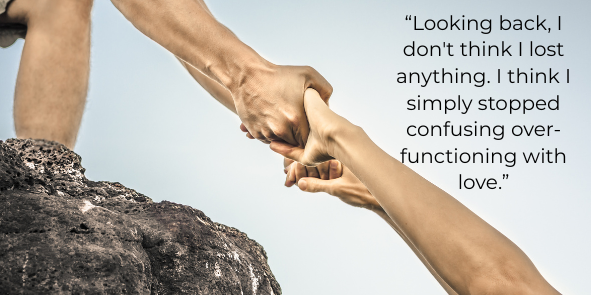
Looking back, I don't think I lost anything. I think I simply stopped confusing over-functioning with love.
There is another layer to this, especially for those who have spent years in an unsafe or unpredictable relationship. When attachment feels essential to our safety, it can actually feel safer to turn against ourselves than to fully see the person we're attached to. We learn this early. A child can't simply decide an unsafe caregiver isn't working out and find someone healthier. So the brain often makes sense of what is happening in the place where it has some perceived control: Maybe it's me. Maybe I'm too sensitive. Maybe I need to be easier, better, quieter, more helpful. If the problem is me, then maybe I can fix it and preserve the connection I need.
We can carry versions of this into our adult relationships. Instead of asking, "Why does this person continue to hurt me?" we ask, "What am I doing wrong?" We become more patient, more understanding, less needy, more forgiving, better at anticipating, fixing, smoothing things over. There can actually be a strange sense of safety in believing we're the problem, because if I'm the problem, I have something I can control. Facing the reality that someone we love may continue making choices that hurt us regardless of what we do requires us to confront the limits of our control.Again, isn’t this fascinating to consider? I really resonated with this during my own healing integration period.
Ok, this is where identity reclamation gets interesting. As our nervous system begins to experience more safety, some of the identities we built around maintaining attachment don't fit quite the same anymore. Maybe I'm not actually "easygoing"; maybe I learned not to have preferences. Maybe I'm not responsible for keeping everyone happy; maybe I became incredibly good at reading a room because there was a time when that helped keep me safe. Maybe I'm still generous, compassionate and deeply loving, but I no longer have to abandon myself to be those things.
Perhaps that's what we're reclaiming, not some entirely new version of ourselves, but the ability to choose who we are when survival is no longer making so many of those choices for us.
There can be grief in that too. Some of these ways of being have been with us for a very long time. We may have loved them, valued them, even felt proud of them. Realizing that something we thought was simply "who I am" may also have been connected to how we stayed safe can take some time to integrate. We don't have to reject those parts of ourselves or decide they were somehow wrong. They served us. We just get to decide whether we still need them in the same way.
For me, understanding this intellectually was important, but it wasn't enough. I could think differently about who I was long before I could feel differently. That's one of the reasons somatic work has become such an important part of my own healing and the work I do with others. When the body begins to experience something different, not just understand something different—there is more room for choice.
Maybe that's the remembering. Not finding the person you were before everything happened, but getting curious about who you are when you no longer have to work so hard to stay safe, stay connected, or hold everything together.
And perhaps the question isn't, Who should I become now?
Maybe it's simply, Who am I when I don't have to survive this anymore?
If you're curious about using somatic work to explore some of these patterns in your own healing, you can learn more about the modalities I use on my somatic healing page.